Freedom in Words
J Carter Stone crafts novels where freedom meets tough choices.
Novels
Stories of freedom and tough choices.
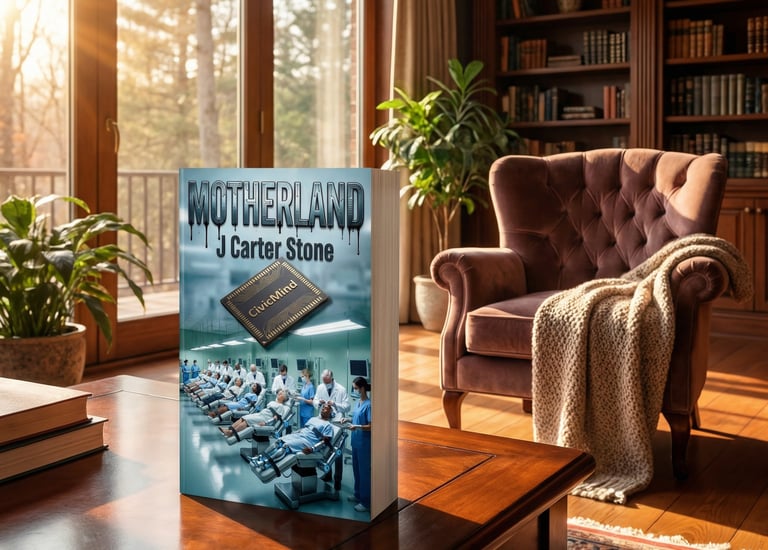
MOTHERLAND - A Novell
In a future where the state controls every aspect of human existence, a woman confronts the chilling realities of total surveillance and absolute power. Motherland explores a dystopian world stripped bare of freedom, where loyalty is demanded and individuality is a crime. J. Carter Stone crafts a haunting examination of what we sacrifice when we surrender to authoritarian rule, and the quiet resistance that flickers in the hearts of those who refuse to be broken.
For readers who demand unflinching storytelling and moral complexity, Motherland delivers a masterwork of speculative fiction. Stone's prose is uncompromising, her vision unrelenting. This is not escapism—it's a mirror held up to the fragile freedoms we take for granted, a warning wrapped in literature that lingers long after the final page. After all, we might be just one election away from losing all freedoms.
For your convenience, you can use this tool to make sure that you messages are approved by CivicMind.
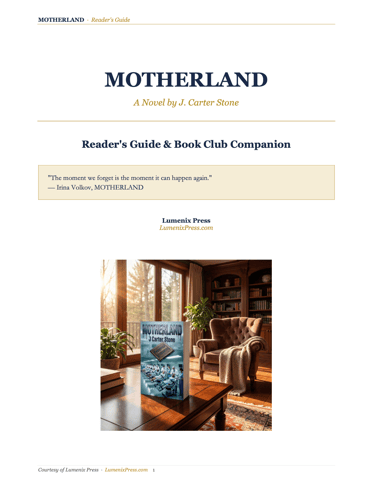
MOTHERLAND: A Reader's Guide was built for every kind of reader who wants to stay inside this novel after the last page — book clubs large and small, literary circles, college and high school classrooms, homeschool families exploring political fiction alongside history, and individuals who felt the book's urgency and want to understand why. The guide moves through all thirty-five chapters and the prologue with detailed summaries of every major storyline: Maya Chen's discovery of CivicMind hidden in government spreadsheets, the babushkas of San Francisco who remember September First flowers and Gagarin, the conversation between Rosa Delgado and John Perkins that lit the fuse, and Bernard Winters dying in the White House cursing God while Rosa steps into the hallway and says three words: Begin Phase Two. It maps the novel's full ensemble — eleven major characters, each with their own arc — and gives every reader the context to see how J. Carter Stone built a single catastrophe from a hundred ordinary choices.
The discussion questions are designed to work whether your group is moved by the novel or troubled by it, whether they're asking how tyranny rises or how individuals survive it. You'll find character-focused deep dives into Maya, Alex, Sergei Volkov, and Victoria Mallory alongside thematic sections on the gradualism of oppression, the seduction of certainty, moral compromise under pressure, the psychology of the chip, and the justice — or injustice — of the aftermath. The guide breaks open the novel's most philosophically charged scenes: the babushkas on what it meant to believe, Lyudmila's answer to why she finally left, Rosa's tribunal statement that is honest and monstrous at once, and Alex's 3 AM confession that the most terrible thing is how much he misses the certainty the chip gave him. Writing exercises, simulation activities, and a curated further reading list connecting the novel to the real history it inhabits — all of it ready for a classroom, a living room, or a kitchen table.
Download a FREE Readers' Guide for Groups/Individuals


© 2026. All rights reserved.